
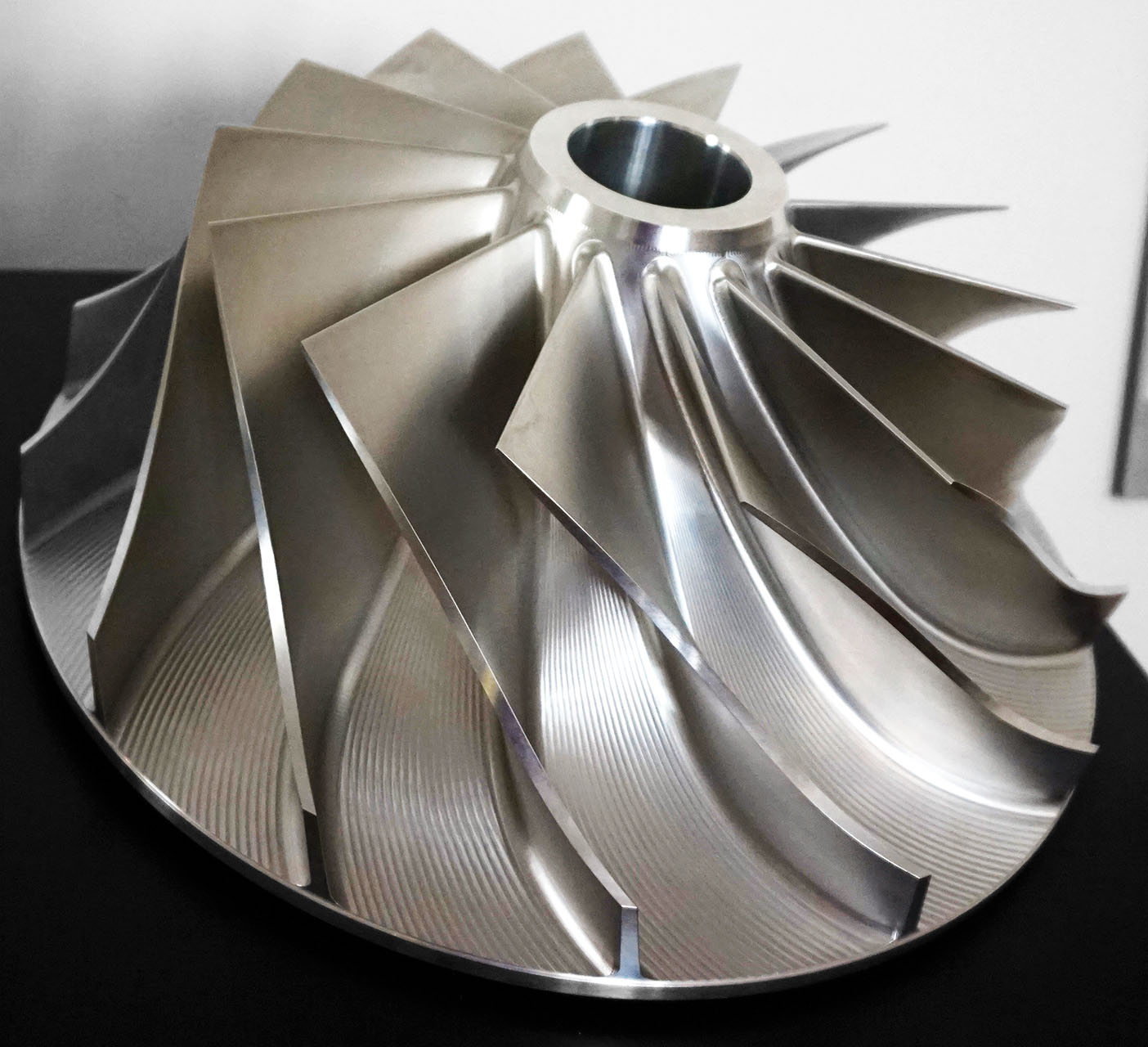
Impellers are sensitive to both mass distribution and mounting repeatability. An impeller can measure well on a balancing machine yet produce a different result after assembly if the bore, key, taper, register, shaft fit or seating condition changes its running centre.
Typical impellers
- Pump impellers
- Blower and compressor-type impellers that behave as rigid rotors at the balancing condition
- Process impellers and paddle-type rotors
- Machined or fabricated impellers after repair
- Impellers balanced on their service shaft or on suitable tooling
Common causes of impeller unbalance
Material loss from erosion or corrosion, weld repair, blade repair, uneven deposits, machining, casting variation, replacement of balance plugs or weights, and off-centre mounting can all change the mass centre. Before balancing, loose parts, cracks, unacceptable damage and unstable deposits should be addressed.
Rotor size capability
| Parameter | Current declared capability |
|---|---|
| Rotor weight | Below 800 kg |
| Maximum diameter | 1.3 m |
| Rotor length | 400 mm to 2.5 m |
For impellers without integral journals, the practical limit is often set by the available shaft, mandrel, bore, taper or fixture arrangement rather than by diameter alone.
Single-plane vs two-plane balancing
Thin impellers may be adequately represented by one correction plane when couple unbalance is negligible. Wider impellers, double-suction impellers and assemblies with meaningful axial separation can require two-plane balancing. The correction planes must correspond to locations where mass can actually be adjusted safely.
Correction methods
Correction may involve controlled grinding or drilling at approved locations, addition or adjustment of balance weights, or another method permitted by the component design. Blade thinning, hub drilling or welding should not be improvised without confirming allowable locations and structural limits.
What the customer should provide
- Impeller type and service
- Mass, diameter and axial width
- Bore, taper, keyway, register or shaft details
- Normal operating speed
- Whether the impeller is balanced alone or as part of an assembly
- Photographs of both faces, bore/hub and previous repair areas
- OEM balance requirement where available
Balancing report
RDB can document identification, setup, initial condition, correction and final measurement. For impellers mounted on tooling, the setup should be recorded because fixture repeatability can materially affect a tight residual-unbalance requirement.
Subang Jaya workshop
Impeller balancing is carried out at the RDB workshop in Jalan Subang 4, Subang Jaya. Send the bore or shaft arrangement together with overall dimensions so tooling feasibility can be reviewed before delivery.