
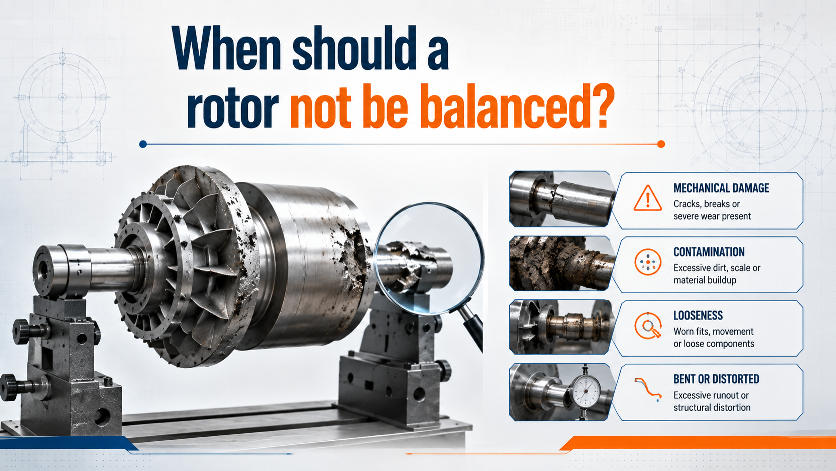
Balancing is a correction process for mass unbalance. It should not be used to hide structural damage, unsafe condition, unstable contamination or geometry defects that require repair first.
1. Cracks or structurally unsafe repairs
A cracked hub, blade, weld, shaft or disc is a structural integrity problem. Spinning the rotor can be hazardous, and adding correction weight does not repair the defect. The component should be assessed and repaired or rejected before balancing.
2. Loose parts or moving internal material
Loose balance weights, internal debris, liquid, product, shot, scale or unsecured parts make the mass distribution variable. A rotor whose unbalance vector changes because material moves cannot be balanced reliably until the moving condition is eliminated or intentionally controlled.
3. Significant bend or unacceptable runout
A bent shaft, eccentric journal or distorted shell should be corrected to the mechanical requirement first. Balancing may reduce centrifugal force about the measured axis, but it does not restore straightness, concentricity or clearance geometry.
4. Damaged journals or unreliable mounting surfaces
Heavily worn, tapered, pitted, coated or too-short journals can prevent stable support. A damaged bore, register or taper can create the same problem for a rotor balanced on tooling. If the mounting axis is not repeatable, the result is not trustworthy.
5. Unknown hazardous contamination
Rotors from process plants can contain chemical residue, biological contamination, asbestos-containing material, radioactive contamination or trapped pressure. Unknown or unsafe material history should be resolved before unloading or spinning the component.
6. Trapped pressure or stored energy
Sealed cavities, pressurised vessels, springs, hydraulic accumulators or other stored-energy features require safe isolation. A balancing machine is not the place to discover that a component was not depressurised.
7. The rotor is changing between runs
If repeated measurements without correction show large vector movement, investigate looseness, mounting repeatability, temperature, deposits and moving parts. Continuing to add or remove mass can chase a moving target.
8. Flexible behaviour requires a different procedure
Rigid-rotor balancing procedures assume the rotor shape does not change significantly with speed in a way that affects the balance state. A rotor with important flexible behaviour may require specialised balancing methods, additional speed ranges or a high-speed facility.
9. The correction itself would damage the rotor
If the only available correction would require drilling a critical flange, thinning a blade below allowable thickness, welding an unsuitable material or weakening a pressure boundary, stop and agree a different engineering method.
10. The machine problem has not been separated from rotor unbalance
If a rotor repeatedly verifies within tolerance but installed vibration remains high, do not keep removing material simply to chase the machine vibration. Diagnose alignment, bearings, resonance, looseness, aerodynamic or hydraulic excitation and assembly condition.
What should happen instead?
The correct sequence is usually: inspect → clean or make safe → repair geometry or structural defects → verify mounting repeatability → balance → verify and document. Balancing belongs near the end of that chain, not at the beginning.
RDB’s intake requirements are described on the Material Safety page.