
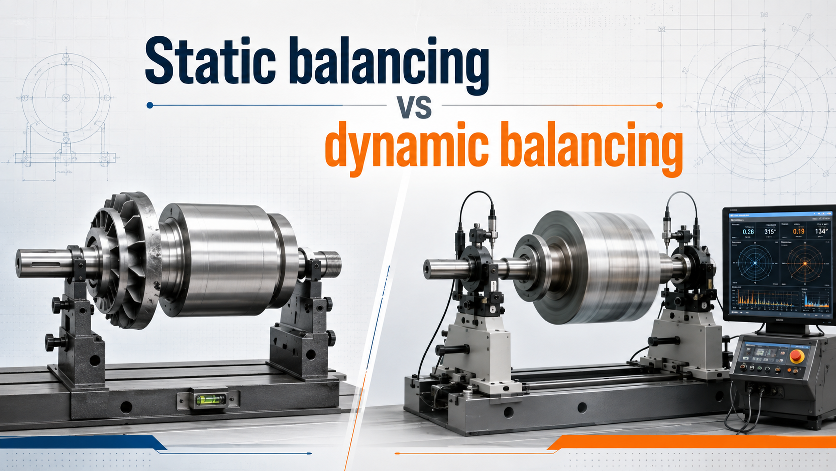
Static balancing and dynamic balancing address related but different conditions. A rotor can be statically balanced and still contain a rotating couple that creates vibration when it spins.
What is static balancing?
In simple terms, static balancing places the rotor’s centre of mass on the rotational axis so it does not repeatedly roll to a heavy spot under gravity. A thin disc with a single dominant heavy point can often be corrected this way.
Static balancing does not require the rotor to be spun at normal balancing speed. Knife edges, low-friction rollers or other methods can reveal a heavy spot in suitable components.
What is dynamic balancing?
Dynamic balancing rotates the rotor and measures the response caused by unbalance. A two-plane balancing machine can determine corrections at separated axial planes, allowing both net force unbalance and couple unbalance to be reduced.
How can a statically balanced rotor still be dynamically unbalanced?
Imagine equal masses added near opposite ends of a rotor, positioned 180° apart. The overall centre of mass can remain on the shaft axis, so the rotor may not show a gravitational heavy spot. When spinning, however, the two separated centrifugal forces create a rotating couple. The supports experience dynamic force even though the rotor appears statically balanced.
Single-plane dynamic balancing is still dynamic balancing
The term “dynamic balancing” is sometimes used as though it always means two planes. In practice, a rotor can be spun and corrected in one plane when its geometry makes couple effects negligible. The important distinction is between the unbalance condition being controlled, not the marketing label.
Typical applications
| Rotor type | Likely approach |
|---|---|
| Thin pulley or narrow disc | Static or single-plane dynamic balancing may be sufficient, depending on speed and requirement |
| Wide fan wheel | Often two-plane dynamic balancing |
| Long drum or roller | Normally two-plane dynamic balancing |
| Shaft assembly with separated masses | Normally two-plane dynamic balancing |
Why static balancing can be attractive
It is simple and can be useful for low-speed or narrow components where the required quality is modest. It can also be a preliminary manufacturing check. Its limitation is that it cannot directly identify couple unbalance that only becomes apparent during rotation.
Why dynamic balancing is used for industrial rotors
Industrial fans, rollers, impellers and shaft assemblies commonly have enough axial length and operating speed for couple effects to matter. Dynamic measurement provides phase and magnitude information under rotation and allows correction to be distributed between appropriate planes.
Do not confuse balance with installed vibration
Dynamic balancing controls residual unbalance. It does not automatically correct bent shafts, alignment, resonance, bearing defects, looseness or fluid forces. The rotor balance result and the machine vibration result should be treated as related but separate engineering measurements.
Related article: Single-plane vs two-plane balancing.